
Iva Matsen: The Woman Who Wouldn't Take No for an Answer


What does a revolutionary look like? Sometimes she's a middle-aged woman with a quiet voice and a bit of youthful shyness she never quite outgrew. She carried a conviction she couldn't set down: too many people hear a sermon on Sunday and never act on it. What if the church followed the sermon with real help for people in need? It was a simple question, and it would change countless lives.
Three successive pastors at her own church turned her down, and a large downtown church told her the idea belonged in a smaller congregation. Then she met Dr. Clinton Ostrander of University Congregational Church, a pastor willing to try something new. He offered to create a position for her as Work Projects Secretary. Iva and her husband, Joseph, left their small Presbyterian church and made the leap.
From a Sermon to a Movement
Dr. Ostrander preached a sermon called "The Church Can Do It" and tucked a flier into that Sunday's bulletin listing about ten unmet needs in the community, from visiting isolated residents of behavioral health institutions to finding Christian foster homes for youth vulnerable to justice system involvement. Members were invited to sign up for the cause that called to them.
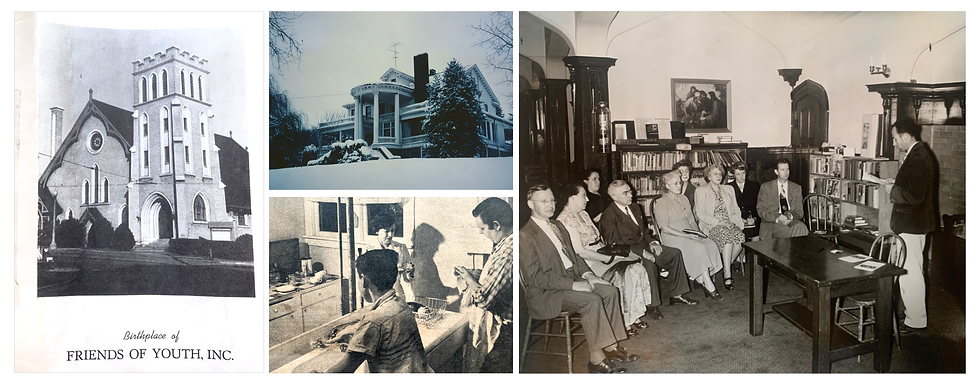
The response was surprisingly good. One working group, focused on reducing youth contact with the criminal justice system, transformed into Friends of Youth, started with nine founders. A year later, in 1951, 22 members signed the Articles of Incorporation, prepared by Joseph Matsen, who handled the organization's legal matters free of charge for many years. These were times of very little money and more dedication than funds. Early meetings were held beside a fireplace in the back of the sanctuary of University Congregational Church (when it stood at E. 43rd and Brooklyn Ave., Seattle), in Sunday School rooms, and in private homes.
Built by Ordinary People
Attorney George Apostol, the first president, remembered that only three people came to the first meeting. Undeterred, members spent months learning from social workers, school administrators, and Judge Long of the Juvenile Court. They partnered with the King County Welfare Department (now known as the Washington Department of Social and Health Services), training volunteers to interview prospective foster parents, and more than 150 homes were eventually recommended. Hazel Turman leased her Green Lake home for a nominal sum, and it became Friends of Youth’s very first group foster home.
A Home Answers a Prayer
When Dr. Ostrander passed away, and Iva fell ill, nearly every other church project faded, but Friends of Youth kept going. Then a Seattle Post-Intelligencer editorial asked, "Where's the Home?", calling for a place for boys released from a Chehalis-based state institution with nowhere to go. Ward and Mrs. Griffin, driving along Lake Washington, spotted an old 17-room house for sale. They had no idea where the boys would come from, but they sold their grocery store, bought the house, and opened the first Griffin Home in Renton in 1954.

75 Years Later
Iva wrote that Griffin Home had "barely scratched the surface of the need." Seventy-five years after that first step from concern to action, Friends of Youth carries the same spirit forward. Iva's story proves that ordinary people can create something extraordinary. It began with one person who heard "no" over and over, but kept knocking anyway.
Channel the spirit of Iva Matsen today, and positively impact the lives of youth, young adults, and families in your community. Learn more at friendsofyouth.org/support-us.


Document tasks sometimes require quick solutions rather than complicated software. Having accessible PDF Tools can make it easier to organize files, convert documents, and prepare materials for sharing, particularly when working on a device with limited installed applications.
What a powerful reminder that quiet determination can spark real change. Iva Matsen’s ability to turn a sermon into lasting community action echoes how meaningful names can reflect purpose and identity—much like choosing a thoughtful Chinese name using a ChineseName generator. It’s inspiring how one person’s conviction, like Iva’s, can ripple outward, shaping organizations and lives for decades.
Iva Matsen's determination really resonates with me. I remember pushing through countless Moto X3m, never giving up until I found the solution. It’s amazing how persistence can lead to unexpected victories!
What a motivational tale about Iva Matsen! Her will to overcome challenges strikes a deep chord with me. In a collaborative project, I recall having to defend my novel idea while everyone else was skeptical of it. Although it seemed overwhelming, we succeeded in producing something sprunky original!
Iva Matsen’s story highlights the power of persistence, a quality that comes in handy in Slope 2 when every run demands quick decisions and the courage to try again after a setback.